

Pathways to Prosperity: Louisiana 2026
Published: Apr 17, 2026
Executive Summary
In 2014, The Data Center published "The Transformative Possibility of the New "Energy Boom" in Southeast Louisiana, highlighting tens of billions of dollars of investments to come in liquified natural gas (LNG) terminals, chemical manufacturing, and refineries that promised to produce thousands of jobs. However, over the last decade, despite $90 billion in new capital investment, and GDP peaking in 2023, job growth in Louisiana has been flat and the state’s population has declined by 52,000 people. Without a doubt, the number one reason people move long distances is for work opportunities. Without growth in permanent jobs, the state is likely to continue losing population.
Job growth and decline by state
Percent change 2015–2025 (annual averages)
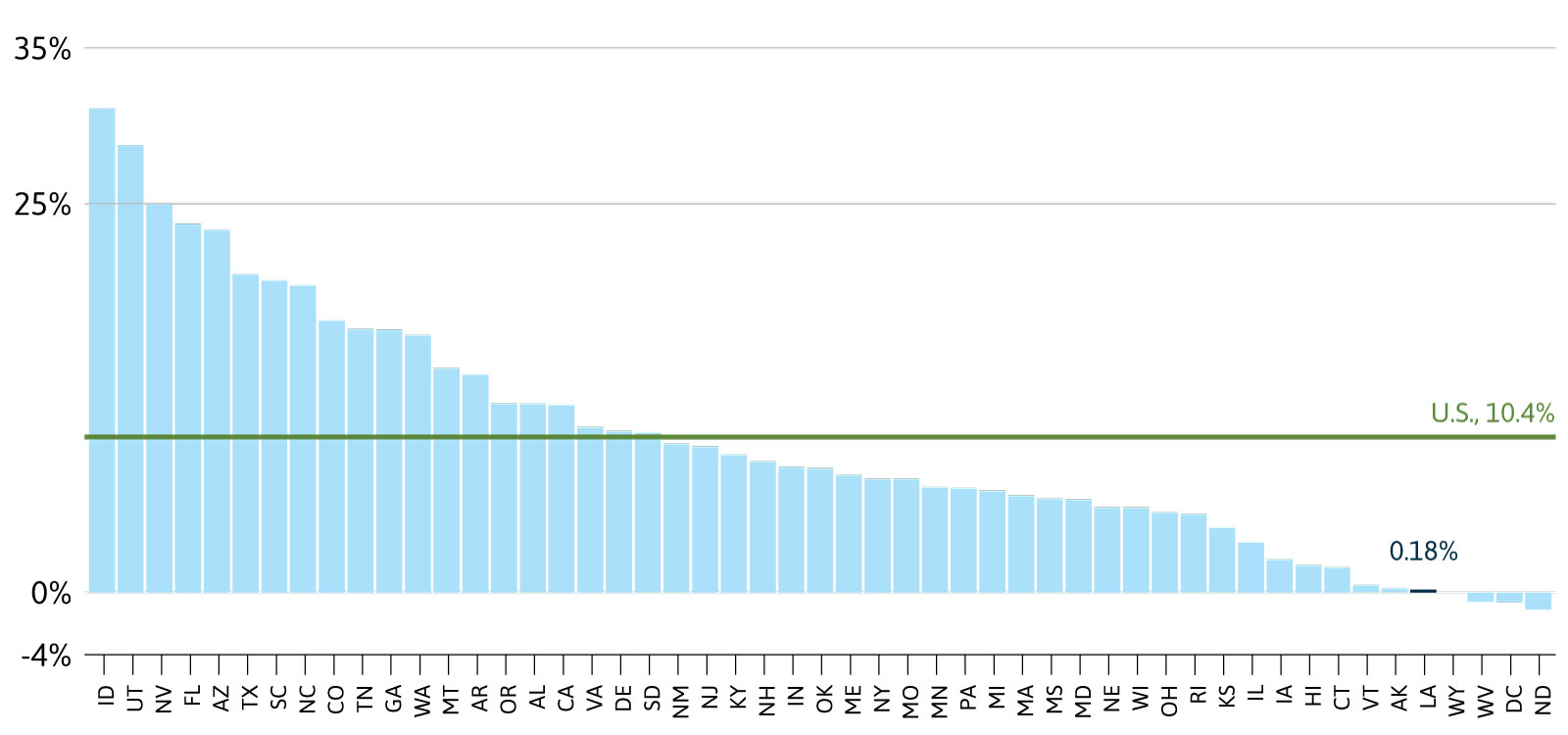
Source: Bureau of Labor Statistics.
As the state embarks on a new wave totaling $100 billion in capital investment — in LNG projects, steel manufacturing, and AI data centers — this report examines the overall impacts of the last wave of industrial expansion. We examine economic indicators that reflect the financial well-being of Louisianans, indicators of pollution related to the state’s expanded industrial base, and health indicators with links to air, water, and soil pollution.
Economy. While U.S. employment has grown 10.4 percent since 2015, Louisiana managed just 0.18 percent growth. Median household income, at under $61,000, has not budged in real terms since 2010. Meanwhile, the cost of living has surged — two working adults now need to earn nearly $99,000 combined to support a family of four, a 19 percent jump in just five years. Louisiana’s real estate values have collapsed in the national rankings — falling from 28th in 2015 to third from the bottom by 2024.
Pollution. Louisiana ranks 1st in the nation for nitrogen oxide emissions from refineries and 2nd in the nation for fine particulate matter and carbon monoxide. Louisiana leads all states in cancer risk from toxic air pollution, with more than 41 residents per million at risk — a rate 25 percent higher than Texas. Toxic sites are concentrated in the state’s most populous parishes. Calcasieu leads with 31 industrial sites emitting hazardous toxins and 14 active Superfund sites, followed by East Baton Rouge with 27 and 16 respectively. Industrial spills have worsened dramatically — rising from an average of 5.6 annually in the late 1980s to 34.4 over the most recent decade.
Health. Louisianans are 37 percent more likely to suffer from chronic obstructive pulmonary disease than the national average, 36 percent more likely to have a stroke, and 16 percent more likely to have a heart attack according to 2022 data. Louisiana leads the nation in prostate cancer, with 157 cases per 100,000 men. One in nine newborns is born at low birth weight — 37 percent above the national average. Louisiana mothers are nearly 47 percent more likely to die from pregnancy-related causes than the average American woman. While pollution is not the sole cause, the links between air, water, and soil contamination and these health conditions are well-documented.
A decade ago, Southeast Louisiana stood on the threshold of what appeared to be a generational economic boom. Billions in petrochemical and manufacturing investment promised tens of thousands of job openings. That promise has gone unfulfilled. While capital and billions of dollars in tax subsidies did flow into refineries, chemical plants, and LNG facilities, job growth has failed to materialize.
Tracking cost of living, real estate trends, pollution exposure, and health outcomes is a necessary step toward understanding what is actually happening to Louisianans and making the case that economic development must be measured not only in capital invested and GDP, but in the quality of life it delivers to families.
Endnotes
George Hobor and Elaine Ortiz, “The Transformative Possibility of the New ‘Energy Boom’ in Southeast Louisiana” (New Orleans, LA: The Data Center, January 30, 2014), https://www.datacenterresearch.org/reports_analysis/the-transformative-possibility-of-the-new-energy-boom-in-southeast-louisiana/.
Louisiana Economic Development, “Challenges Met. Progress Delivered: Louisiana Economic Development, 2016–2023” (Baton Rouge, LA: Office of the Governor, John Bel Edwards, 2023), https://gov.louisiana.gov/assets/LegacyReports/LEDLegacyReport.pdf; “Louisiana’s Industrial Boom: Growth in the Gulf,” BIC Magazine, September/October 2024, https://www.bicmagazine-digital.com/bic/september_october_2024/MobilePagedArticle.action?articleId=2005023#articleId2005023; Louisiana Economic Development, 2022 Annual Report (Baton Rouge: Louisiana Economic Development, 2023), https://www.opportunitylouisiana.gov/wp-content/uploads/docs/23led103_led-annualreport2022_single_all_pages_lowres.pdf; U.S. Bureau of Economic Analysis, “Gross Domestic Product by State and Personal Income by State, 3rd Quarter 2023,” December 21, 2023, https://www.bea.gov/news/2023/gross-domestic-product-state-and-personal-income-state-3rd-quarter-2023; U.S. Census Bureau, “State Population Totals and Components of Change: 2020–2025,” last revised January 27, 2026, accessed April 2, 2026, https://www.census.gov/data/tables/time-series/demo/popest/2020s-state-total.html; U.S. Census Bureau, “State Intercensal Population Totals: 2010–2020,” last revised November 5, 2024, accessed April 2, 2026, https://www.census.gov/data/tables/time-series/demo/popest/intercensal-2010-2020-state.html.
U.S. Census Bureau, “Why People Move,” September 18, 2023, https://www.census.gov/library/stories/2023/09/why-people-move.html; Society for Human Resource Management, “Americans Most Often Move for Work,” December 20, 2023, https://www.shrm.org/topics-tools/news/talent-acquisition/americans-often-move-work.
Elizabeth Murrill, “Louisiana Industrial Boom Tops $100B, Could Trigger Population Gains,” New Orleans CityBusiness, March 6, 2026, https://neworleanscitybusiness.com/blog/2026/03/06/louisiana-100-billion-economic-investments/.
Elise Plunk, “Tax Breaks for LNG Facilities Will Cost Louisiana Parishes $21 Billion: Report,” New Orleans City Business, December 3, 2024, https://neworleanscitybusiness.com/blog/2024/12/03/tax-breaks-for-lng-facilities-will-cost-louisiana-parishes-21-billion-report/; Robert Habans and Alexander S. Kolker, “A Close Look at Data on Oil and Gas Employment in Louisiana” (New Orleans, LA: The Data Center, March 26, 2026), https://www.datacenterresearch.org/reports_analysis/a-close-look-at-data-on-oil-and-gas-employment-in-louisiana/.